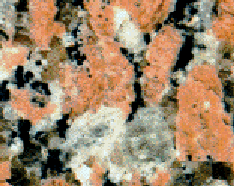
 Granite
is a coarse or medium-grained intrusive igneous rock that is rich in quartz
and feldspar (k-feldspar and plagioclase); it is the most common plutonic
rock of the Earth's crust, forming by the cooling of magma (silicate melt)
at depth.
Granite
is a coarse or medium-grained intrusive igneous rock that is rich in quartz
and feldspar (k-feldspar and plagioclase); it is the most common plutonic
rock of the Earth's crust, forming by the cooling of magma (silicate melt)
at depth.
Granite
is a coarse or medium-grained intrusive igneous rock that is rich in quartz
and feldspar (k-feldspar and plagioclase); it is the most common plutonic
rock of the Earth's crust, forming by the cooling of magma (silicate melt)
at depth.
Granite has found its biggest use as paving block and as a building stone. The quarrying of granite was, at one time, a major mining activity in the New England and southeastern states. Today, except for tombstones, for which there is a continuing demand, the production of granite is geared to the fluctuating market for highway construction and veneer or sheet rock used in the facing of large commercial buildings.
Granite may occur in dikes or sills (tabular bodies injected in fissures and inserted between other rocks), but more characteristically it forms irregular masses of extremely variable size, ranging from less than a few square miles to larger masses (batholiths) that are often hundreds or thousands of square miles in area.
The principal constituent of granite is feldspar. Both plagioclase feldspar and potassium feldspar are usually abundant in it, and their relative abundance has provided the basis for granite classifications. In most granite, the ratio of the dominant to the subdominant feldspar is less than two. This includes most granites from the eastern, central, and southwestern United States. Granites in which plagioclase greatly exceeds potassium feldspar are common in large regions of the western United States and are thought to be characteristic of the great series of batholiths stretching from Alaska and British Columbia southward through Idaho and California into Mexico. Granites with a great excess of potassium feldspar over plagioclase are known from New England, but their most extensive development is in Nigeria.
 Rocks containing
less than 20 percent quartz are almost never named granite, and rocks containing
more than 20 percent (by volume) of dark, or ferromagnesian, minerals are
also seldom called granite. The minor essential minerals of granite may
include muscovite, biotite, amphibole, or pyroxene. Biotite may occur in
granite of any type and is usually present, though sometimes in very small
amounts.
Rocks containing
less than 20 percent quartz are almost never named granite, and rocks containing
more than 20 percent (by volume) of dark, or ferromagnesian, minerals are
also seldom called granite. The minor essential minerals of granite may
include muscovite, biotite, amphibole, or pyroxene. Biotite may occur in
granite of any type and is usually present, though sometimes in very small
amounts.
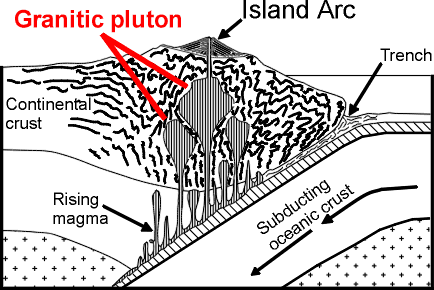
Granitic magmas are generated at convergent plate boundaries where the
oceanic lithosphere (the outer layer of the Earth composed of the crust
and upper mantle) is subducted so that its edge is positioned below the
edge of the continental plate or another oceanic plate. Heat will be added
to the subducting lithosphere as it moves slowly into the hotter depths
of the mantle. This will cause the overlying wedge of crustal material
to melt. The formation of granite is often envisioned as a two-stage process.
The first stage involves partial melting of lower crust and perhaps subducted
oceanic material to form a magma of andesitic composition (see discussion
of andesite). The produces island arcs and volcanic mountain chains comprised
of andesite and diorite. The base of these andesite/diorite piles then,
in turn, partially melts to form magmas of granitic composition.