OBSIDIAN
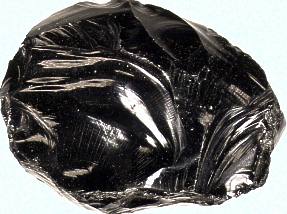 Obsidian is a natural glass of volcanic origin that is formed by the rapid cooling of viscous lava. Obsidian is extremely rich in silica, low in water, and has a chemical composition similar to rhyolite. Obsidian has a glassy luster and is slightly harder than window glass. Though obsidian is typically jet-black in color, the presence of hematite (iron oxide) produces red and brown varieties, and the inclusion of tiny gas bubbles may create a golden sheen. Other types with dark bands or mottling in gray, green, or yellow are also known.
Obsidian generally contains less than 1 percent water by weight. Under high pressure at depth, rhyolitic lavas may contain up to 10 percent water, which helps to keep them fluid even at a low temperature. Eruption to the surface, where pressure is low, permits rapid escape of water and increases the viscosity of the melt. Increased viscosity impedes crystallization, and the lava solidifies as a glass.
Different obsidians are composed of a variety of crystalline materials. Their abundant, closely spaced crystallites (microscopic embryonic crystal growths) are so numerous that the glass is opaque except on thin edges. Many samples of obsidian contain spherical clusters of radially arranged, needlelike crystals called spherulites. Microlites (tiny polarizing crystals) of feldspar and phenocrysts of quartz may also be present.
Obsidian was used by American Indians and many other primitive peoples for weapons, implements, tools, and ornaments and by the ancient Aztecs and Greeks for mirrors. Because of its conchoidal fracture (smooth curved surfaces and sharp edges), the sharpest artifacts were fashioned from obsidian; some of these, mostly arrowheads, have been dated by means of the hydration rinds that form on their exposed surfaces through time. Obsidian in attractive and its variegated colors make it useful as a semiprecious stone.
| PREVIOUS PAGE | ID ANOTHER IGNEOUS ROCK | IGNEOUS ROCKS HOME |