PUMICE
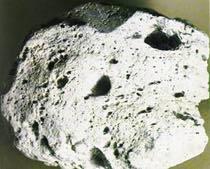 Pumice is a very porous, frothlike volcanic glass that has long been used as an abrasive in cleaning, polishing, and scouring compounds. It is also employed as a lightweight aggregate in precast masonry units, poured concrete, insulation and acoustic tile, and plaster.
Pumice is pyroclastic igneous rock that was almost completely liquid at the moment of eruption and was so rapidly cooled that there was no time for it to crystallize. When it solidified, the gasses dissolved in it were suddenly released, the whole mass immediately consolidated. Had it cooled under more pressure, it would have formed a solid glass, or obsidian. Any type of lava, if the conditions are favourable, may assume the pumiceous state, but basalt and andesite do not occur as often in this form as does rhyolite.
Small crystals of various minerals occur in many pumices; the most common are feldspar, pyroxene, amphibole, and zircon. The cavities (vesicles) of pumice are sometimes rounded and may also be elongated or tubular, depending on the flow of the solidifying lava. The glass itself forms threads, fibres, and thin partitions between the vesicles. Rhyolite aumices are white, andesite pumices often yellow or brown, and pumiceous basalts (such as occur in the Hawaiian Islands) pitch black.
Pumices are most abundant and most typically developed from silica-rich magmas; accordingly, they commonly accompany obsidian. In minute fragments, it has an exceedingly wide distribution over the Earth's surface. It occurs in all the deposits that cover the floor of the deepest portion of the oceans and is especially abundant in the abyssal red clay. Much of this pumice has been derived from submarine volcanic eruptions, but its presence is also accounted for by the fact that it will float on water for months and is thus distributed over the sea by winds and currents. After a time it becomes waterlogged and sinks to the bottom, where it gradually disintegrates and is incorporated in the muds and oozes of the ocean floor.
| PREVIOUS PAGE | ID ANOTHER IGNEOUS ROCK | IGNEOUS ROCKS HOME |