MYLONITE
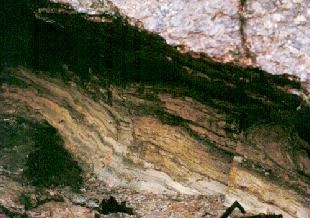 The formation of mylonites (fault rocks) is complex and involves successive stages of deformation, recovery, and recrystallization. During deformation, pressure solution may contribute to fabric development, but deformation processes are basically mechanical in nature. Mylonitization also involves the chemical processes of metasomatism and recrystallization. In these, as well as in the deformation processes, fluids are important. Other variables that control the nature of the mylonitization include the nature of the protolith, the confining pressure, the temperature, and the continuity of the rock mass.
The deformation processes involved in mylonitization include microfracturing, twinning, dislocation glide, and
grain-boundary sliding. Microfracturing is a process in which microscopic fractures develop within and between grains, in response to stress. In minerals with cleavage, the intragranular fractures may follow the cleavage. Feldspars, in particular tend to fracture during mylonitization, and in some cases, quartz, calcite, olivine, pyroxene, and biotite do so as well. Twinning is another mechanism by which crystals may reflect strain. Dislocation glide refers to a shift in the position of a defect within a crystal lattice. The defect may change size or may simply change positions. Grain-boundary sliding is a process in which grains shift positions relative to adjoining grains, with the shift occurring along the grain boundary. All of these processes are granular adjustments made within rocks to accommodate an applied stress. The adjustments result in a foliated rock.
In addition to the mechanical processes of deformation involved in mylonite formation, recrystallization, and metasomatism are important in the development of the character of these rocks. Recrystallization is the process in which strain energy is reduced by the nucleation and growth of new crystals within and at the margins of host crystals. Fluid flow in fault zones and ductile deformation zones is significant in promoting mechanical deformation and recrystallization. Major metasomatic effects are also produced by fluids. For example, fluids have removed more than 60% of the volume of material in some mylonite zones. Pressure solution promotes some of this volume loss.
Together, combinations of the processes described above yield mylonitic rocks. The particular combination of
processes that produces the specific fabric elements and mineral composition of any given mylonite is a function of the rock and fluid composition and the strain history.
| PREVIOUS PAGE | ID ANOTHER METAMORPHIC ROCK | METAMORPHIC ROCKS HOME |