SLATE
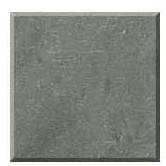 Slate is a very fine-grained, metamorphic rock that splits readily into thin slabs having great tensile strength and durability. A true slates does not, as a rule, split along the bedding plane but along planes of cleavage, which may intersect the bedding plane at high angles. Slate is formed under low-grade metamorphic conditions (low temperature and pressure). The original material was a fine clay, usually in the form of a sedimentary rock (e.g., a mudstone or shale). The parent rock may be only partially altered so that some of the original mineralogy and sedimentary bedding are preserved; the bedding of the sediment as originally laid down may be indicated by alternating bands, sometimes seen on the cleavage faces. Cleavage is an inherited structure, the result of pressure acting on the rock when it was deeply buried beneath the Earth's surface. The direction of cleavage depends upon the direction of the stresses applied during metamorphism.
Slate may be black, blue, purple, red, green, or gray. Dark slates usually owe their color to carbonaceous material or to finely divided iron sulfide. Reddish and purple varieties owe their color to the presence of hematite (iron oxide), and green varieties owe theirs to the presence of much chlorite, a green micaceous clay mineral. The principal minerals in slate are muscovite and biotite (in small, irregular scales), chlorite (in flakes), and quartz (in lens-shaped grains).
Slates are split from quarried blocks about 3 inches thick. A chisel, placed in position against the edge of the block, is lightly tapped with a mallet; a crack appears in the direction of cleavage, and slight leverage with the chisel serves to split the block into two pieces with smooth and even surfaces. This is repeated until the original block is converted into 16 or 18 pieces, which are afterward trimmed to size either by hand or by means of machine-driven rotating knives.
Slate is sometimes marketed as dimension slate and crushed slate. Dimension slate is used mainly for electrical panels, laboratory tabletops, roofing and flooring, and blackboards. Crushed slate is used on composition roofing, in aggregates, and as a filler. Principal production in the United States is from Pennsylvania and Vermont.
| PREVIOUS PAGE | ID ANOTHER METAMORPHIC ROCK | METAMORPHIC ROCKS HOME |