CALCITE
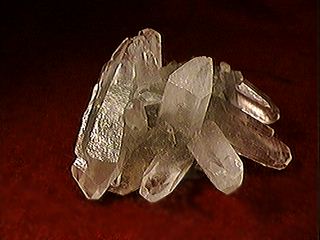 The name calcite is from the Latin calx, meaning burnt lime. Calcite has many habits, The most common are hexagonal prisms with simple to complex terminations;scalenohedra, often with combinations of other forms;rhombohedra, either acute or flattened; and tabs with well-developed basal faces. Polysynthetic twinning is common but usually requires a microscope to detect. Calcite is also found as a massive rock-forming mineral, as nodules or crusts, in speleothems, and as fine to coarse granular aggregates.
Calcite is a common and widespread mineral. It is an essential and major mineral in limestones and marbles, occurs in cave deposits, and occurs as a vein mineral with other carbonates, sulfides, barite, fluorite, and quartz. Calcite also occurs in some rare carbonate-rich igneous rocks and is a common cement in some sandstones. Calcite is common as a weathering product. Organic calcite is common in shells and skeletal material.
There are several varieties of calcite. Iceland spar refers to clear calcite, usually in rhombohedral cleavage fragments; dogtooth spar refers to crystals with steep scalenohedral forms; nail-head spar refers to flat rhombs or stubby prismatic crystals.
Calcite has two polymorphs, aragonite and vaterite. It
is isostructural with magnesite, siderite, sphaerocobaltite, smithsonite, nitratite, dolomite and gaspeite. Calcite and rhodocrosite form extensive solid solutions at room temperature
and a complete solid solution above about 550 degrees C. Calcite forms limited solid solutions with ankerite and dolomite at all temperatures.
| PREVIOUS PAGE | ID ANOTHER MINERAL | MINERALS HOME |