DOLOMITE
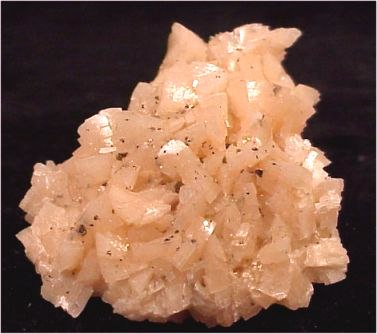 Dolomite is named after D. de Dolomieu, a French chemist and geologist. Crystals are typically rhombohedral, having the shape of cleavage fragments, often with curved faces. Less commonly they are prismatic or steep rhombohedra. Lamellar twinning is nearly always present but may be hard to see. Massive dolomite, showing rhombohedral cleavage, is common. Dolomite is isostructural with calcite). Fe and Mn may substitute for Mg in substantial amounts. Co, Pb, Zn, Ce, or excess Ca may also be present.
Dolomite is a common mineral, found in massive carbonate sediments and in marbles, often with calcite. It also occurs in hydrothermal veins with fluorite, barite, other carbonates, and quartz, and as a secondary mineral or alteration product in limestone. Dolomite is isostructural with calcite, and a number of other minerals.
| PREVIOUS PAGE | ID ANOTHER MINERAL | MINERALS HOME |