Garnet
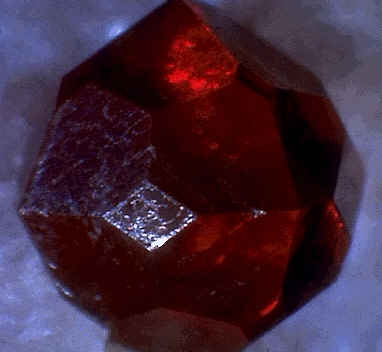 The composition of naturally occurring garnets rarely approaches the formulas given in textbooks because of extensive atomic substitution. The specific name applied is that of the component that is present in largest amount. Ferrous iron and magnesium are interchangeable, and a series of intermediate compositions exist between almandine and pyrope; similarly, series of intermediate compositions exist between almandine and spessartine and between
grossular and andradite.
The composition of naturally occurring garnets rarely approaches the formulas given in textbooks because of extensive atomic substitution. The specific name applied is that of the component that is present in largest amount. Ferrous iron and magnesium are interchangeable, and a series of intermediate compositions exist between almandine and pyrope; similarly, series of intermediate compositions exist between almandine and spessartine and between
grossular and andradite.
Garnets differ somewhat in their mode of typical occurrence, as follows:
- Almandine: The common garnet of gneisses and schists is almandine. it is also recorded from granites, rhyolites, and pegmatites.
- Pyrope: Less common than the other garnets (except uvarovite), pyrope occurs in ultrabasic igneous rocks and serpentinites derived from them. It also occurs in high-grade, magnesium-rich metamorphic rocks.
- Spessartine: Many garnets from granite pegmatites and in vesicles in rhyolites are spessartine or intermediate between spessartine and almandine. Spessartine also occurs in metamorphosed manganese-bearing rocks.
- Grossular: Grossular is typically formed by contact or regional metamorphism of impure limestones and dolostones and, thus, is associated with calcite, wollastonite, and idocrase.
- Andradite: Andradite is formed by the metasomatic alteration of limestones by iron-bearing solutions, and it commonly occurs associated with ore deposits in calcareous rocks.
- Uvarovite: Uvarovite, which is rare, occurs in association with chromite and serpentinite.
Garnets, being resistant to both mechanical and chemical breakdown, also occur as detrital grains in sands and sandstones.
Garnet has some value as an abrasive because it is fairly hard, lacks cleavage, and hence breaks into irregular grains. Although garnet is a common mineral, material suitable for use as an abrasive has seldom been found in workable quantity. The requirements are for large isolated crystals that are crushed to provide the garnet sand used to make sandpaper. Severai thousand tons of such garnet have been produced annually at Gore Mountain, in the Adirondack Mountains of New York. Transparent unflawed garnet of good color can be cut into attractive gemstones. Much of the red garnet jewelry consists of pyrope from Czechoslovakia. Uvarovite would make a magnificent gemstone, but it does not occur in sufficiently large pieces. Green garnet gemstones are cut from a variety of andradite known as demantoid.
p>
| PREVIOUS PAGE | ID ANOTHER MINERAL | MINERALS HOME |