Olivine
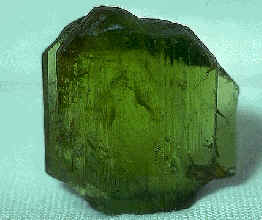 The olivine series is an example of continuous solid solution of two components, Mg2SiO4 and Fe2SiO4. Three names are used currently: forsterite for pure or nearly pure Mg2SiO4, fayalite for pure or nearly pure Fe2SiO4, and olivine for the common intermediate varieties. Forsterite and olivine are incompatible with free silica because they react with it to give
pyroxene; as a consequence, olivine and quartz cannot crystallize together in a rock. Fayalite, however, does not react in this way, and fayalite occurs in some granites and rhyolites.
The olivine series is an example of continuous solid solution of two components, Mg2SiO4 and Fe2SiO4. Three names are used currently: forsterite for pure or nearly pure Mg2SiO4, fayalite for pure or nearly pure Fe2SiO4, and olivine for the common intermediate varieties. Forsterite and olivine are incompatible with free silica because they react with it to give
pyroxene; as a consequence, olivine and quartz cannot crystallize together in a rock. Fayalite, however, does not react in this way, and fayalite occurs in some granites and rhyolites.
The composition of olivine generally corresponds closely to (Mg,Fe)2SiO4, there being little replacement by other elements. Substitution by calcium is evidently strongly temperature dependent, because only a little of the olivine from plutonic rocks contains more than 0.1 percent CaO, whereas most of the olivine of volcanic rocks contains more than this amount, typically ranging up to a maximum of about 1 percent CaO. Manganese is present in most olivines and generally correlates positively with Fe content, ranging from about 0.1 percent in forsterites up to 2.5 percent in fayalite. Olivines from ultrabasic rocks generally contain some nickel, commonly about 0.3 percent. A noteworthy feature of olivine is the virtual absence of aluminum; evidently replacement of Mg and Si by Al is unacceptable in the olivine structure.
Olivine alters readily. Hydrothermal alteration generally results in the formation of serpentine, whereas surface or near-surface alteration results in oxidation of the iron and removal of the magnesium and silica, commonly leaving a brown or red-brown pseudomorph
that consists of goethite or hematite.
Olivine is typically a mineral of mafic and ultramafic igneous rocks; in some places, it constitutes major rock masses (dunite); some basalts contain nodules of granular olivine, some that are derived from the earth’s mantle. Olivine is a common mineral in stony and stony-iron meteorites. Forsterite is formed by the metamorphism of dolomitic limestone. Fayalite melts at 1205°C, forsterite at 1890°C; thus, magnesium-rich olivine, with a very high melting point, is used in the manufacture of refractory bricks. Transparent olivine of good color has been cut into attractive gemstones (peridot).
p>
| PREVIOUS PAGE | ID ANOTHER MINERAL | MINERALS HOME |