Potassium feldspar
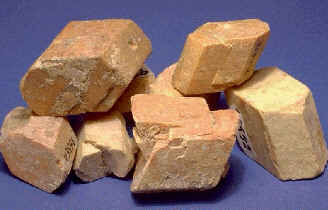 The potassium feldspar minerals occur in several distinct forms having different but intergradational optical and physical properties. Sanidine, the monoclinic high-temperature polymorph, occurs chiefly in volcanic rocks. Orthoclase, another monoclinic variety, and microcline (triclinic) occur in a wide variety of igneous and metamorphic rocks that
have crystallized at intermediate to low temperatures. Adularia, which may be either monoclinic or triclinic, is the name given to a form with a distinctive habit, one simulating rhombohedra, that occurs chiefly in low-temperature hydrothermal veins.
The potassium feldspar minerals occur in several distinct forms having different but intergradational optical and physical properties. Sanidine, the monoclinic high-temperature polymorph, occurs chiefly in volcanic rocks. Orthoclase, another monoclinic variety, and microcline (triclinic) occur in a wide variety of igneous and metamorphic rocks that
have crystallized at intermediate to low temperatures. Adularia, which may be either monoclinic or triclinic, is the name given to a form with a distinctive habit, one simulating rhombohedra, that occurs chiefly in low-temperature hydrothermal veins.
Research has clarified the relationships among these forms. Microcline and sanidine are polymorphs with an order-disorder relationship, the Si and Al atoms are randomly distributed over their positions in sanidine, but they are ordered in microcline. The disordered form is the more stable polymorph above about 700°C. Orthoclase and adularia are structurally intermediate between sanidine and microcline. Much orthoclase probably crystallized originally as sanidine, which subsequently underwent an ordering of some of its Al and Si atoms, but adularia is evidently a metastable form that has developed under conditions of rapid crystallization within the stability field of microcline. Such rapid crystallization would presumably prevent the attainment of an ordered arrangement of Si and Al.
Sanidine occurs in potassium-rich volcanic rocks such as rhyolite and trachyte. Orthoclase is the characteristic potassium feldspar of igneous rocks, occuring both alone and in perthitic intergrowth with albite; it also occurs in some metamorphic rocks. The variety adularia is formed at comparatively low temperatures, typically in veins. Microcline, being an ordered polymorph, is usually formed at lower temperatures than is orthoclase, the disordered polymorph. Thus, microcline is the common potassium feldspar of pegmatites and hydrothermal veins. Crystals several feet long are not uncommon in pegmatites. Microcline also occurs in metamorphic rocks.
Large quantities of microcline and microcline perthite are mined from granite pegmatites and used in the manufacture of glass,porcelain, and enamel (e.g., from pegmatites in North Carolina). Amazonite, also called amazonstone, is sometimes cut and polished for use as an ornamental stone.
p>
| PREVIOUS PAGE | ID ANOTHER MINERAL | MINERALS HOME |