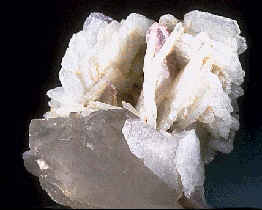
 Plagioclase is actually a group of minerals. There is a continuous series from pure albite, NaAlSi3O8 (Ab), to pure anorthite, CaAl2Si2O8 (An). The series is arbitrarily divided into six species or subspecies as follows:
Plagioclase
Plagioclase is actually a group of minerals. There is a continuous series from pure albite, NaAlSi3O8 (Ab), to pure anorthite, CaAl2Si2O8 (An). The series is arbitrarily divided into six species or subspecies as follows:
Distinguishing the plagioclase series minerals from the potassium feldspars is difficult. Look for the twinning striations on basal cleavage surfaces. Differentiation between the individual species or subspecies within the plagioclase series is best done optically or by X-ray diffraction, but careful density determinations can give a good indication of composition. Rock type is also a useful guide (see below).
Some albite, oligoclase, and labradorite in coarse cleavages commonly exhibit a play of colors in shades of blue or blue-green, yellow, and brown. Those with bulk compositions in the albite-oligoclase range, which are typically light colored, are called penstenite.
Most anorthite occurs in contact metamorphosed limestones. Bytownite and labradorite are characteristic of igneous rocks of gabbroic composition and of the anorthosites; andesine, of andesites and diorites; oligoclase, of monzonites and granodiorites; albite, of granites and granitic pegmatites. The albite of pegmatites is of two distinct types; massive and lamellar, the latter widely referred to as cleavelandite. The plagioclases are also common in metamorphic rocks; in low-grade schists and gneisses, the plagioclase is typically albite; in medium-grade rocks, it is typically oligoclase or andesine. Pure or nearly pure albite occurs as veins in a few schists.
Albite and oligoclase are mined from some pegmatites and used in the manufacture of ceramics and as the abrasive in toothpaste. p>