Sulfur
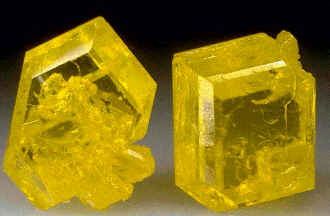 Sulfur is found around fumaroles, volcanic vents, and in hot spring deposits associated with recent or active volcanism. The sulfur may precipitate directly from vapors or be produced as a result of bacterial action on sulfate minerals. Hydrothermal sulfide deposits may also contain native sulfur, usually in the near-surface oxidized zone.
The largest concentrations of sulfur are associated with salt domes formed of marine evaporite deposits. The evaporites are dominantly halite, but usually contain gypsum, anhydrite, and calcite. When the top of a salt dome encounters fresh meteoric groundwater within roughly a kilometer of the surface, halite is dissolved. Continuous upward movement of salt from its source allows a cap of less soluble calcite and gypsum to accumulate at the top of a salt dome. The cap commonly consists of an outer/upper zone of calcite, transitioning inward to gypsum and then anhydrite. Hydrogen sulfide is produced by anaerobic sulfur-reducing bacteria provided that hydrocarbons (oil/gas) are available by the following general reaction:
CaSO4 + CH4(hydrocarbons) + bacteria = H2S + CaCO3 + H2O
The hydrogen sulfide is oxidized either by oxygen in the groundwater, hydrocarbons, or other chemical processes to form elemental sulfur:
2H2S + O2=2S + 2H2O
The actual reaction paths are greatly more complicated than these and may additionally involve aerobic bacteria. Because generation of sulfur involves breaking down sulfates and production of calcite, the sulfur is concentrated at the calcite—sulfate boundary in the cap rock of salt domes.
Sulfur from salt domes is usually extracted by injecting superheated water into the sulfur. The hot water mobilizes the sulfur and both water and sulfur are then pumped to the surface for processing. Sulfur is principally used to manufacture sulfuric acid, which is itself used in many chemical processes. Major uses of sulfuric acid include the manufacture of phosphatic fertilizer, leaching copper from copper ore, and a wide variety of other chemical processes. Sulfur also may be added directly to soil as a nutrient. A substantial amount of the sulfur used for industrial purposes is derived as a byproduct of extracting metals from sulfide minerals.
| PREVIOUS PAGE | ID ANOTHER MINERAL | MINERALS HOME |