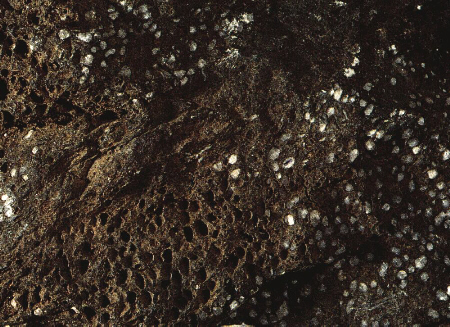
 Basalt is an extrusive igneous rock that is low in silica content, dark in color, and comparatively rich in iron and magnesium.
BASALT
Basalt is an extrusive igneous rock that is low in silica content, dark in color, and comparatively rich in iron and magnesium.
Some basalts are quite glassy, and many are very fine-grained and compact; it is more usual, however, for them to exhibit porphyritic structure, with larger crystals (phenocrysts) of olivine, pyroxene, or feldspar in a finely crystalline matrix (groundmass). Olivine and pyroxene are the most common porphyritic minerals in basalts although plagioclase feldspar is also found. Basaltic lavas are frequently spongy or pumiceous; the steam cavities become filled with secondary minerals such as calcite, chlorite, and zeolites.
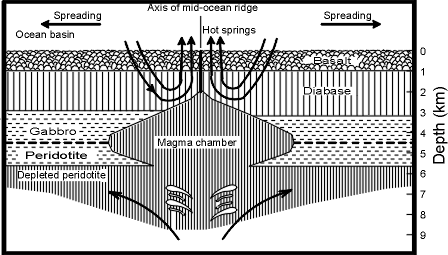
Because basalts are so abundant they are subdivided on a chemical and petrographic basis into two main groups: tholeiites and the alkali basalts. Tholeiitic basaltic lavas are characterized by plagioclase with the pyroxenes augite, pigeonite or hypersthene. They predominate among the lavas of mountain belts; their flows may build enormous plateaus, as in the northwestern United States, the Deccan of India, and the Paraná Basin of South America. The active volcanoes of Mauna Loa and Kilauea in Hawaii erupt tholeiitic lavas. Alkali basalt contains olivine and, commonly, a the pyroxenes diopside or titaniferous augite. Alkali basalts predominate among the lavas of the ocean basins (divergent plate margins as pillow lava) and are common among the basic lavas of the forelands and backlands of the mountain belts.
 Minerals of the feldspathoid group occur in a large number of basaltic rocks belonging to the alkali group; nepheline, analcime, and leucite are the commonest. If nepheline entirely replaces feldspar, the rock is known as nepheline-basalt; if the replacement is only partial the term nepheline-basanite is used. Similarly, there are analcime- and leucite-basalts and leucite-basanites. Most nepheline-basalts are fine-grained, very dark-colored rocks and are of Tertiary age. They are fairly common in some parts of Germany and also occur in the United States (as in New Mexico). Leucite-basalts are found principally in Italy, Germany, eastern Africa, Australia, and, in the United States, in Montana, Wyoming, and Arizona. Basalts rich in feldspathoidal minerals such as nepheline and leucite are of uncertain origin. While they occur in ocean basins, they are much more common in continental settings suggesting the continental crust is enriching these basaltic magmas in alkalis and perhaps alumina.
| PREVIOUS PAGE | ID ANOTHER IGNEOUS ROCK | IGNEOUS ROCKS HOME |